

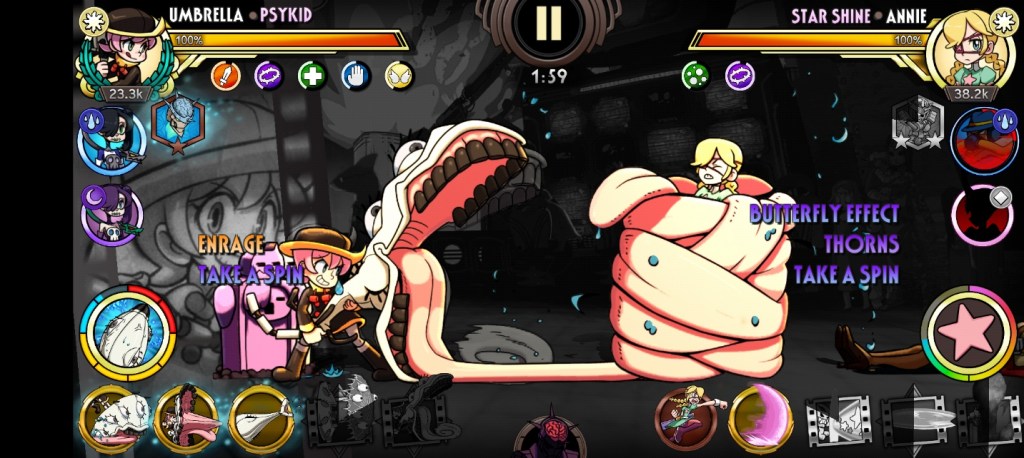
Gacha games make oodles of cash. It’s a model that can get folks hooked on digital lottery tickets, only instead of paying out, the companies give you access to game content. More so than that, they’re habit forming: The developers want you checking in daily, because the more involved with the game you are, the more willing you are to depart with your money. I’ve already demonstrated I’m a sucker for these invasive mobile games, as I previously wrote about Monster Hunter Now. Yet once again, I’m going to be celebrating the game: The game is a unique animal, somewhere between a fighting game and an RPG, and it scratches an itch I am incapable of reaching otherwise.
The original Skullgirls launched in 2012, and is a hand drawn marvel, evoking the mechanical spirit of Marvel vs. Capcom 2. I am also very bad at it, and as the years march on, the dexterity demands of fighting games become a bigger and bigger ask. Fighting games also demand that you find a local community to really benefit. I am not having luck finding fighting game scenes in the Inland Empire, but maybe I’m just not looking hard enough. Still, even without local community, fighting games have historically had a lot to offer.
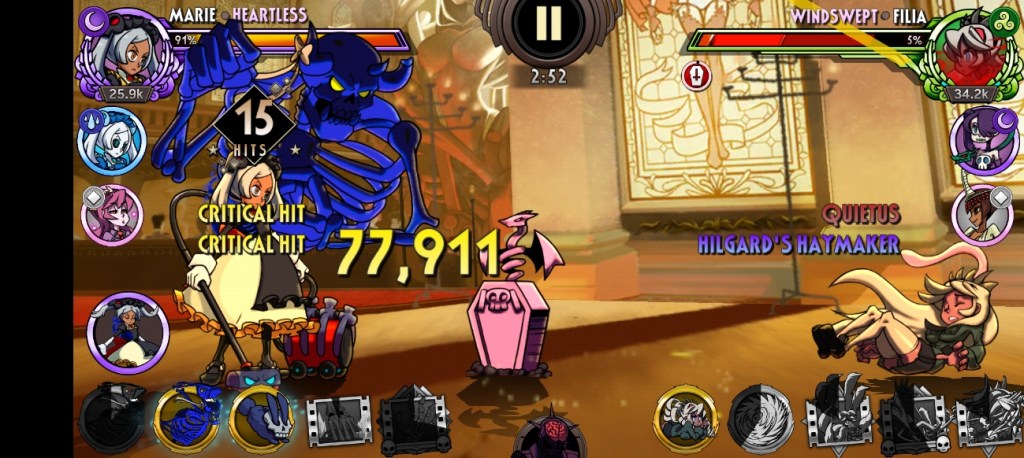
Most fighting games have offered an arcade mode to battle through, but as the genre evolved, single player games became more esoteric. One of my fond childhood memories is the messy N64 fighter, Fighter’s Destiny, which could be an entire entry by itself. In short, that game was my introduction to fighting games hybridizing with other genres, marrying the technical execution of fighters with the gameplay hooks of RPGs. I would find similar great times in Soul Calibur III, Power Stone 2, and the myriad gimmick modes present in the Smash Bros series. Nowadays, Skullgirls Mobile gives me that fusion of flavors in my pocket.
It condenses fighting controls into a series of taps, swipes, and buttons for specials. The mere fact that I can enjoy a fighting game with these controls is worth celebrating, but I mostly want to zoom in on the other genres Skullgirls borrows from. Moves are equipped pre-combat, and come loaded with different stat boosts. Much of the game ends up being pouring over these equips and optimizing for the challenges presented, very reminiscent of a good RPG. These comparisons continue well into the combat itself.
You have a series of standard attacks always available, with special moves available on cooldown, and super moves, called blockbusters, charging up over the course of the battle. While cooldowns for specials are unorthodox for a fighting game, the special charging is familiar. Where the game deviates wildly is with it’s buff and debuff systems. Special conditions are no stranger to fighting games, but they’re usually a gimmick confined to one or two different characters, where here, it is often center stage. There are simple buffs that increase stats, but many of them give birth to a lot of situations one wouldn’t normally encounter in a fighting game. How do you fight when your opponent still takes damage, but doesn’t flinch from the damage? (Imagine long lasting super armor, for those familiar with fighting games) Or what if your blocks have a chance to fail? Your special meter drains when you’re next to the opponent? Or maybe you’ll just drop dead in ten seconds if you don’t do something about it.
In a traditional fighting game, these effects would infuriating. In a primarily single player, or asynchronous multiplayer like Skullgirls Mobile is, these create interesting little puzzles to be solved mid combat or designed pre combat. Maybe I can disable the ability for the opponent to even gain these buffs? Maybe I can just be evasive and wear down my opponent by bleeding them out? On the flip side, the multiplayer here has you assembling a team of your fighters, equipped with some special modifiers to design a little boss fight to be controlled by the CPU for anyone who ends up challenging you.
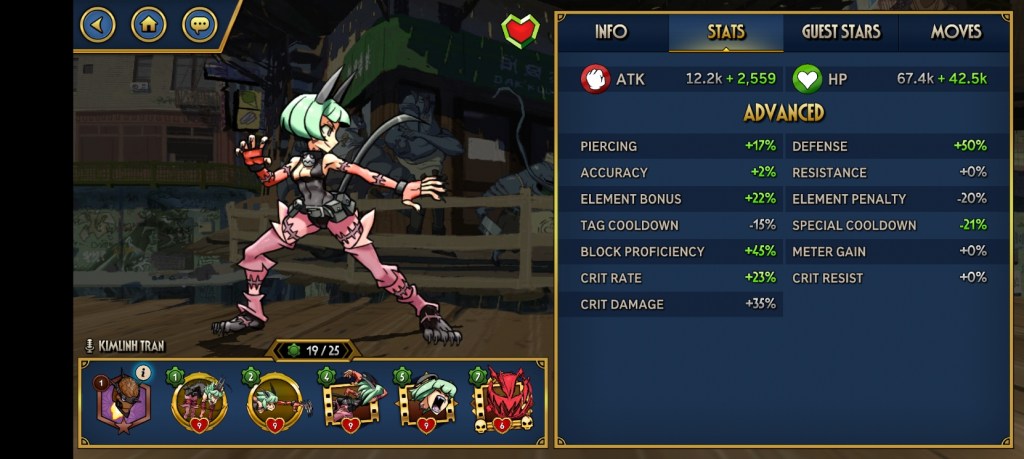
All these delightful design choices mean that I keep coming back to the game because I enjoy it. I take several month breaks at a time, but I know when I’m in the fighting mood, the game will be several updates deep and have plenty more to serve to me. I’ve been playing the game long enough that the allure of pulling for new characters isn’t even the main draw here. I’m coming here to get a fighting experience I can’t get anywhere else, and here I get to pretend I’m actually good at it!
I’d love to hear anyone’s history with fighting games, it’s such a rich genre with a myriad of entry points. Being in the mood for Skullgirls again makes me want to explore more in the genre this year. Maybe this is the year I learn Guilty Gear Strive! Or maybe I’ll just hoot and holler some more at some Plasma Sword with friends.
 Bro Bromero's Broad Blog
Leave a comment