


Every December, I try to reflect on my favorite experiences of the year and give them little write-ups to share with my friends. This is my first year with this blog, so I’m hoping to migrate those writings here so I am not impeded by the Discord text limit. As we approach the middle of November, normally all the big media experiences of the year have presented themselves to me, but Q-UP dashed up right before the finish line and is winning me over, quickly becoming one of my favorite video games of the year.
Q-UP is a send up of the era of modern e-sports. The game, tongue firmly in cheek, presents itself as the solution for unbalanced games, unhealthy metas, and nasty queue times. The perfectly balanced game would be the flip of the coin, and that’s exactly what Q-UP is: A coin is flipped, and you hope it lands on your side three times to win the match. It’s an absurd premise to build a video game around, but it’s still functional and engaging. There are skill grids, loot and equipment, but the beating heart of the game is just a coin flip. All of the auxiliary systems built around it transform it into a game that’s difficult to pin down.
I’ll start by throwing out a word salad of mechanics, genres and inspirations, and then I’ll discuss more in depth: Q-UP is an auto-battling Balatro-like coin flipper incremental with an extensive skill grid and equipment system to approach success from multiple directions. While I said that coin flipping is the core of the game, the progression of the game follows you as you climb the in-game ranking system. You’ll generate a score based on the flip results, and all of your skills and equipment activating. Usually this means you climb up the ranks on winning coin flips and fall on losing, but building your character in a variety of different directions can lead to losing still scoring you rank up points, and astronomically high point gains on winning sides, where you rocket through more than ten ranks at a time in a single flip.
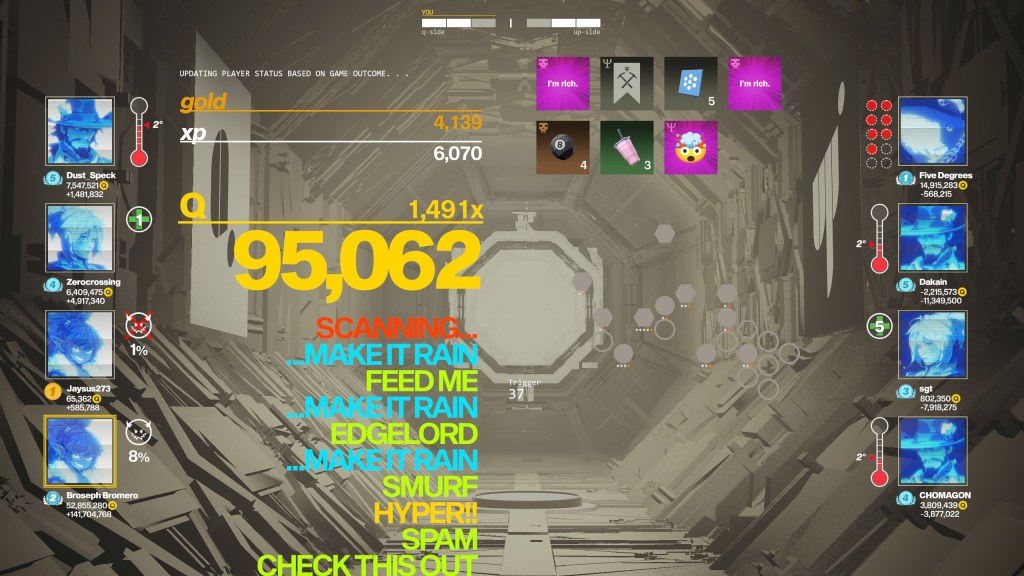
Your score is comprised of your Q value, and your Q mult, which function identically to Balatro’s Chips and Mult. Multiplying these two values together gives you your score for the flip. Q is initially set to 100 on winning throws, but is set to increasingly severe negative numbers on losing flips. Your Q mult is initially 1, and as pictured below can get quite large. Unlike Balatro, this game has you contend with the threat of negative numbers, so if you manage to pump up your Q mult while failing to get your Q out of the negative, you can have some devastating tumbles down the ranked ladder. Unlike a standard competitive game, this isn’t frustrating in the slightest. The core of the game is so absurd, that I could only laugh when I lost one and a half billion points in a single flip. The game even rewarded me with a class unlock with my catastrophic blunder. Every match is a joy to behold, numbers ramping up faster and faster, seeing your build smoothly rocket you upwards, or spectacularly fail, and you are rewarded either way. I had a lot of chuckles yo-yoing back and forth in the ranks, but the game has a strong sense of humor beyond the mechanics.
The developer, Everybody House Games, last made a big splash with the browser based incremental Universal Paperclips. That game is an excellent incremental game (that you can knock out in an afternoon! Give it a whirl, it’s free!) and you can see that reflected in the design of Q-UP. The game while presenting as a sterile e-sport, also has plot threads running through it in an in-game email system. You’ll find yourself quickly hired by the fictional company that designs Q-UP, and dragged through the internal turmoil of a company struggling to make coin flipping a functional game. The plot is light, but you’re never buried in emails, with one or two brief emails at most after every match until you hit a plot point where the emails dry up significantly. I have yet to finish the game as a single class, but I simply had to jump and write something to champion this game, it is a fascinating design. So far, there are not major plot divergences in each playthrough. Trying out a new class has you start a new campaign, so you can skip through most emails once you’ve seen them in an earlier session. While this may hinder some of the replayability, you aren’t here for a complex branching narrative, you’re here to bury yourself in some satisfying build crafting.
While I mentioned earlier that is a hoot to watch numbers spiral out of control during a match, the game is still just a coin being flipped and scored three to five times, so you could easily just step out to pour a coffee and come back to look at your score. The real mechanically juicy gameplay loop here is the skill grid system. Every classes skills are laid out on a vast hexagonal grid consisting of static skills and flex skills. Static skills are locked into specific slots on the grid, where flex skills can be freely moved. Every skill has some sort of trigger, most common being “when you win” “when you lose” and “when a coin is flipped”. Each skill can be activated a set number of times during each flip, although you can spend upgrade points to slowly strengthen your skills. The real joy in this system is that a great deal of the skills care about adjacency and placement. My favorite class so far, the Troll, has a swath of skills that trigger random adjacent skills, so I get an engaging optimization puzzle: Do I surround the tile to maximize the number of activations, or do I only give it a single neighbor for the sake of consistency? Skills are doled out at the rate of almost every other level, and with the level cap of fifty, builds can become surprisingly complex engines, all powered by a stupid little coin flip.
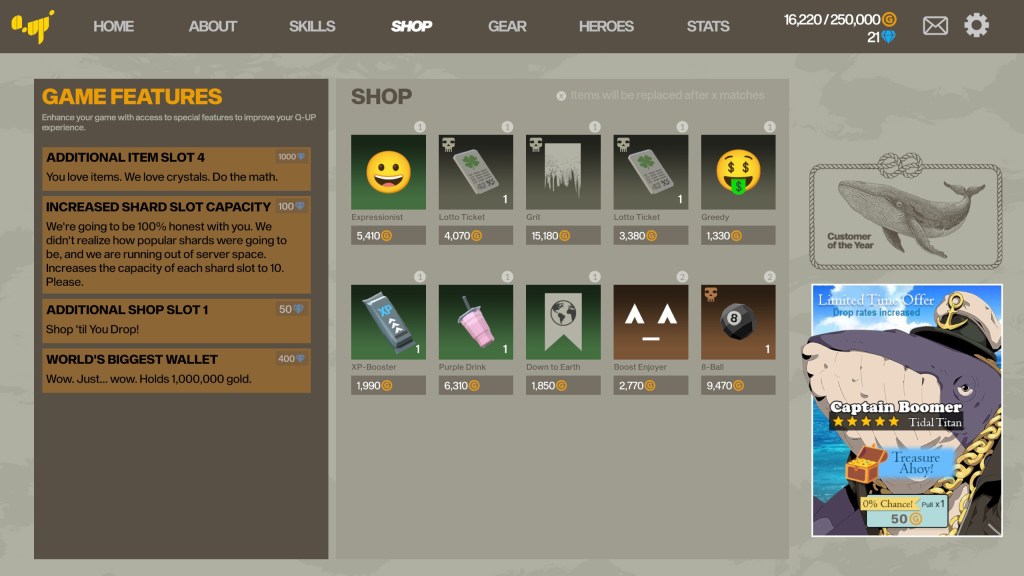
I was torn when gathering screenshots for this game. I wanted to showcase some of the complexity without spoiling the surprises the game has to offer, but one of the mechanics I recently unlocked not present got a good laugh out of me when I realized the game was piling even more mechanics on top of such a premise. One aspect of the game I did not have a chance to explore for this blog post is that this is an actual multiplayer game! While the game will happily fill in bots to make sure that queue times are short, some of those other players are actual folks. You can invite your friends and roll out together. I’m not sure what the rhythm of this would feel like in a party setting, as so much of my time with the game has been exploring the strategy that the menus provide. I imagine this would serve as a great game to just shoot the breeze. You can easily switch from engaging with the systems, to just letting coins flip on their own while you catch up with friends.
I’ll try my best to be active here during December when I start rounding up my favorites of 2025, and I am confident that this game will be ranking highly, unless it really botches the ending. It really made my head spin, and had me reexamining what makes for compelling gameplay mechanics. Could simple progression systems and skill trees get me to play any genre whatsoever? Q-UP firmly demonstrates that you can spin anything out into a strategically rich experience. I eagerly await the game designs that spring up from this game!


 Bro Bromero's Broad Blog
Leave a comment