

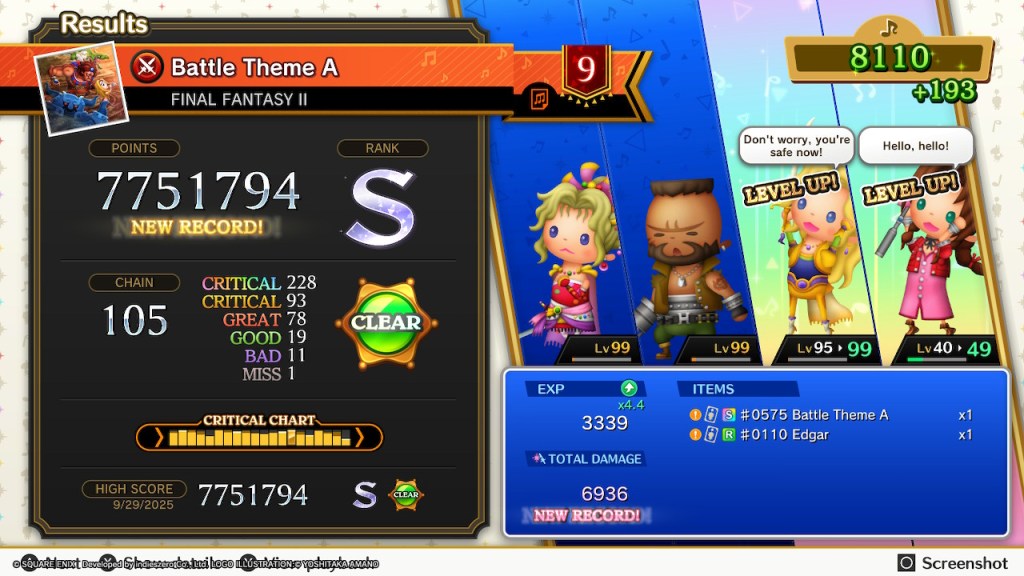
It is hard to determine whether or not Theatrhythm Final Bar Line is a niche game or not. Rhythm games are not usually in the big spotlight anymore, and this game asks that you have some passing familiarity and fondness of the music of the Final Fantasy series. Beyond that, it also asks that you have some interest optimizing your party of characters in a classic RPG fashion. The intersection between all these demands would make you think this is a niche game, but I think it has a much wider appeal.
The Final Fantasy series has some incredible music. It would be hard to walk away from any of those games without remarking how memorable the tunes are. If you haven’t touched Final Fantasy, and wanted to see what a fusion of rhythm and RPG mechanics might look like, this game also serves as a great introduction to the series. Final Bar Line is awash with options to fiddle with the difficulty of the game, so the game is accessible to both the rhythmically challenged and those who are satisfied with nothing less than a 100% perfect clear of a song.
Playing through a song is the bulk of the game, and the mechanics are approachable: You hit a button in time to the music. Occasionally you’ll hold down the button, or flick a control stick in a direction, sometimes even both sticks. As all these inputs begin to layer on top of each other, complexity emerges from an incredibly simple and intuitive control scheme. There isn’t the initial difficulty of learning the finger placements of a plastic guitar, just gripping a standard controller. It doesn’t even demand you know any button placements, as literally any one or two buttons are valid inputs. My biggest slip ups have been when the game asks for simultaneous stick flicks in different directions, which consistently wrecks my brain.
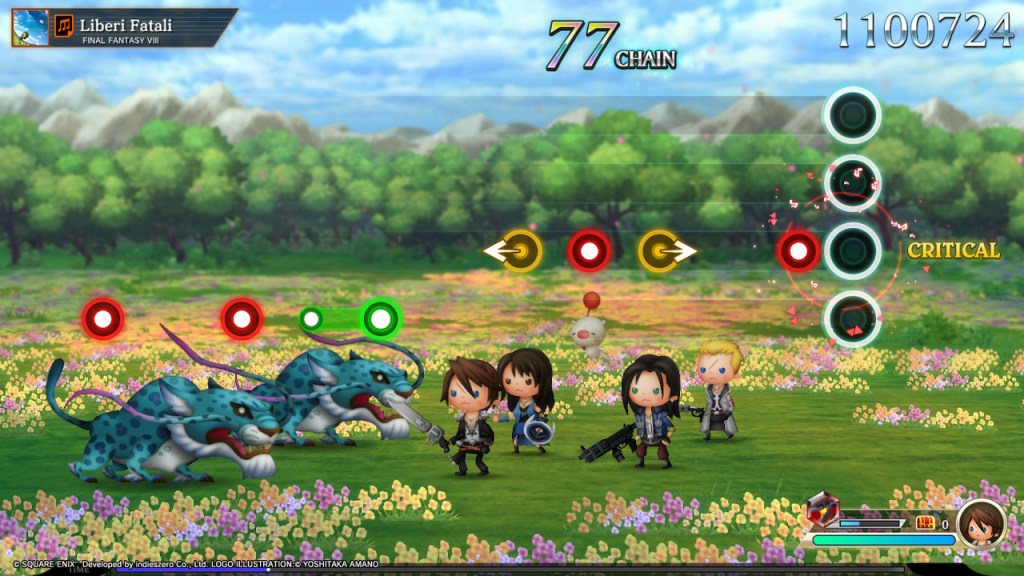
The game offers three or four difficulty levels per song, ranging from rudimentary introductions to rhythm games, to jumbles of notes scattered across the screen. I often play at the hard difficulty level, though I have a good laugh every now and then when I check in on the supreme difficulty level that is only offered on a few songs. Like many games in the genre, performing poorly enough will result in a fail state, but there are ways to pull yourself away from the brink of defeat.
Unlike, Rock Band or Guitar Hero for instance, the quality of your performance is not in flux. In those games, poor performance could be mitigated by picking up the slack and nailing a few measures in a row. In Final Bar Line, missed notes chip away at your party’s HP bar, and here is where the classic Final Fantasy mechanics are woven into the game. Instead of flipping through menus to cast spells and attack, the RPG side of this game is automatic. Hit 70 notes? Your cure spell casts, and recovers some HP. You just entered the second half of the song? Enjoy a buff to your damage output for the remainder of the song. While HP as a concept translates into rhythm games fairly well, damage you inflict upon the enemy is not a native rhythm game concept.
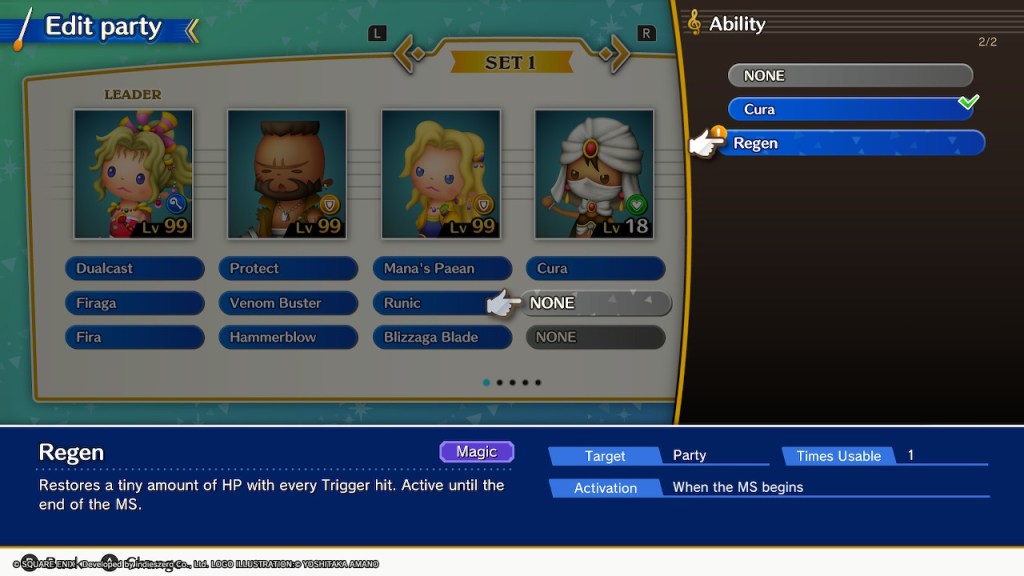
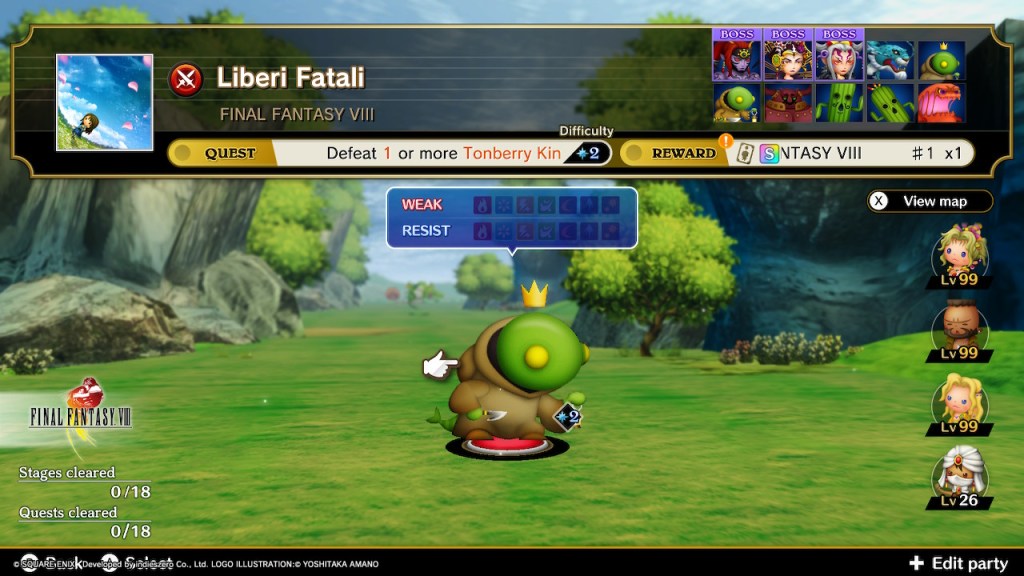
As you play through the songs, your characters will automatically plow through enemies and bosses, depending on their stats, and triggered abilities fire off as you fight. Your score and performance at the end of the song is solely dictated by your rhythmic performance, not how many enemies are felled. One might wonder what the point of the ability management side of the game is if it isn’t reflected in your score. By divorcing score and fight competency, Final Bar Line pulls off a neat trick: You can give it any amount of attention and still be satisfied.
If I just want to jam out and tap buttons, I don’t have to dive into the party system whatsoever. If I want to dive into the story mode’s challenges of knocking out certain bosses and optimizing my parties for little collectibles, I can dedicate more energy to fiddling around menus. All of the little collectibles incrementally improve my performance at the part of the game that only matters if I want to get those collectibles in the first place. Wherever I’m at, the game is willing to meet me at that level.
Playing on the Switch, this flexibility goes even further, meeting me whether I want to play on the couch or in the patio. It even offers multiplayer modes that I have not explored, including an option to tackle songs in a cooperative mode. Above all else, the game even accommodates for me not being a hardcore Final Fantasy fan.
I’ve played Final Fantasy 6, 7, 8 and Tactics, which means there are easily over fifty games I have yet to explore in the series. The vast majority of the music available here are songs new to me, that I have not formed emotional attachments to, and yet I am still having a great time. I find myself smiling when I’m in perfect time, when I’m stumbling through some unknown and intriguing melody or when I get some new trinket or ability. Despite being a game that expects you to be directly in the center of a Venn diagram of super fans, Final Bar Line excels at being an introduction to all facets of its being. Now excuse me as I go get annihilated by Dancing Mad on Supreme difficulty.

 Bro Bromero's Broad Blog
Leave a comment