

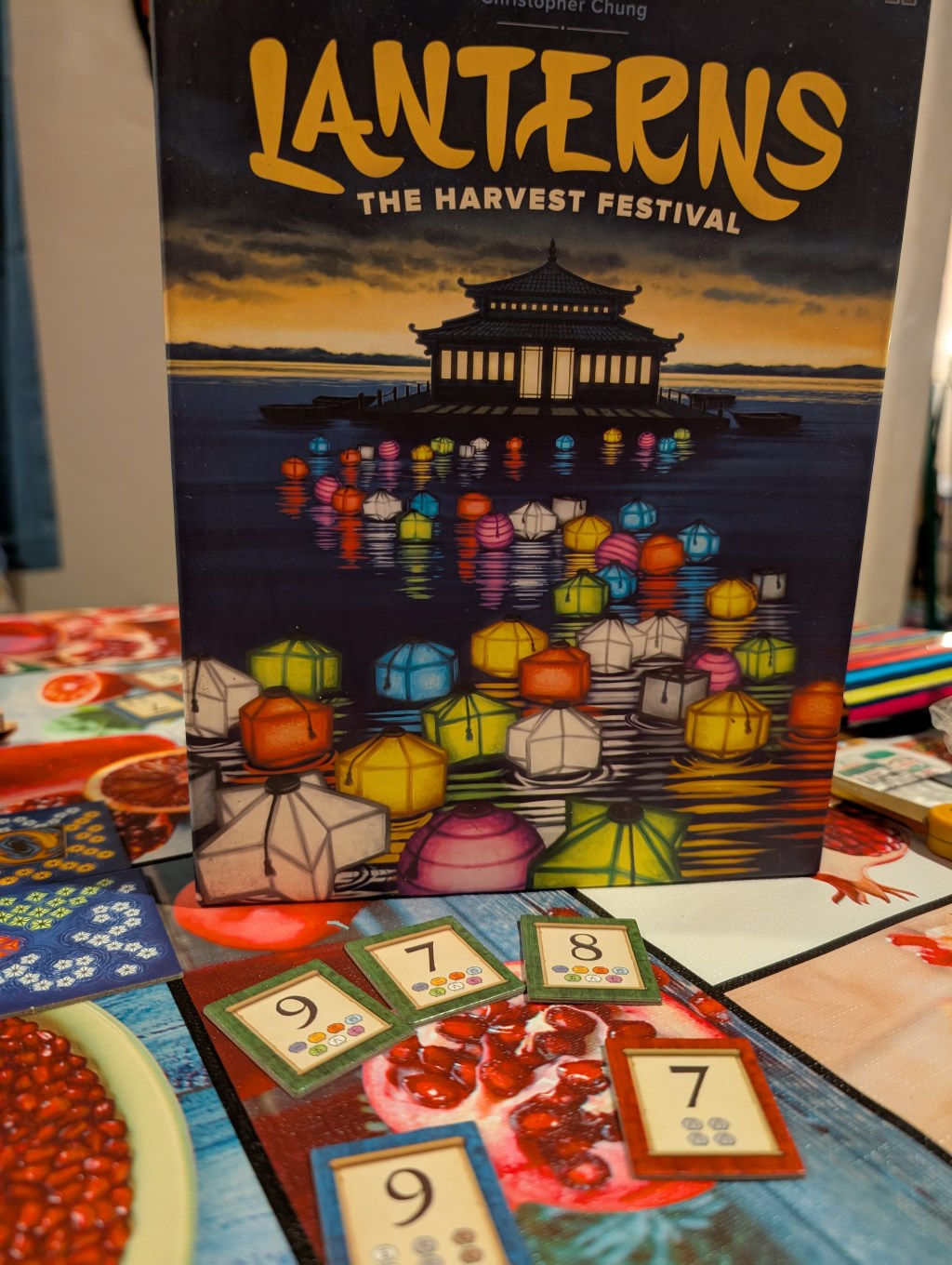
Whoops! I missed a week. It was a hectic week, but I’m happy to be writing again. I recently had a big board gaming weekend, but got too absorbed into the games to get photos and take notes. Whoopsie! When Ana and I got home, we decided to cap off the weekend with one last board game, a light little bit of strategy to cap off a non stop weekend.
Lanterns released a whole decade ago now, but the design on display still shines to this day. Every board game collection benefits from having games that can get anyone to the table, and Lanterns is easily one of the most approachable games I own. Most of our logged games of Lanterns lately have been just Ana and I however. The game does a remarkable job of scaling well for every player count, and plays out in tight thirty minute games, where scores are rarely blowout victories. Tight point races for the entire game make this an engaging experience the whole way through.

The flow of a turn is very straightforward: You have a hand of three lake tiles, and various lantern cards. You have an opportunity to turn in your lanterns for victory points, and you then place a lake tile onto the ever growing board. Placing a lake tile grants you lantern cards for any matching colored sides you make. The big twist to the game is that the tile additionally grants you a lantern of the color that faces you, and then grants every opponent a tile for the color that faces them.
Because every move you make is likely granting all of your opponents some advantage, you are rewarded for scanning across the entire board. Sure, you could generate multiple lanterns if you find an ideal spot, but if the orientation is giving your opponent a critical lantern, you might need to opt for a different move. With every additional player, the choices get you sweating more and more. An additional system of platforms gives a way to trade in unwanted lanterns for more favorable colors, so even if the colors you need aren’t showing up, you often have plays to get your favorable hands.
The dedication tiles serve as your victory points, and they are doled out for lantern hands of three pairs, four of a kind, or one of each of the seven colors. Crucially, the points rewarded for each of these hands lower as they are scored, so being the first to score particular hands will give you a critical point edge over your opponents.

Now, I love my games with lots of moving pieces, but I also have to give out high praise to the games that do away with needless complexity and serve up a highly satisfying core experience. Lanterns is free of excessive bells and whistles, and remains one of the fastest games to teach in my collection. Your lake tile placement benefiting everyone makes for a unique optimization puzzle. This hobby has a tendency for people to place emphasis on the hot new releases of the year, but I urge folks to look at the rich history of games that are already around. We’re already more than a quarter of a century into the big board game revolution, and amazing designs exists around every corner.
Lanterns has had a happy ten years in my collection, and I see it staying in the library. Maybe if we all write a wish onto a lantern and send it out, we’ll see a tenth anniversary edition. Then Lanterns can get more of the spotlight it deserves.
 Bro Bromero's Broad Blog
Leave a comment