

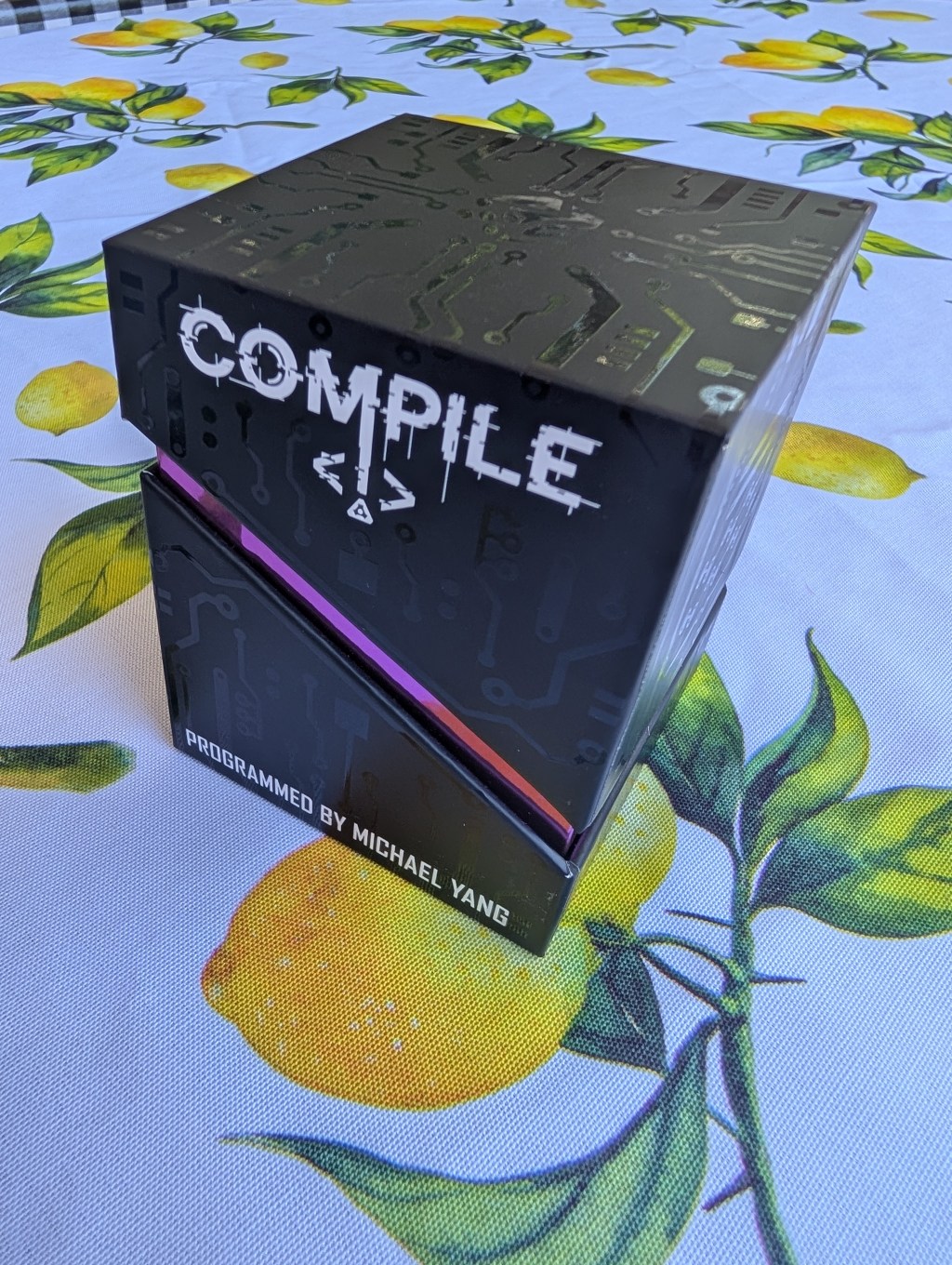
I’m always looking for sharp two player experiences. While my board game collection is sizeable, I live quite far from my core group of friends now, so many of my board game nights nowadays are just me and my wife. This means a lot of my favorite games are tailor made for two. That being said, I haven’t had much luck getting her into games where she needs to sit down ahead of time and put a deck together. No Netrunner or Magic nights at home for me. There’s still a wealth of games that satisfy that itch without the need to dive deep into customization.
Compile: Main 1 is a tightly designed two player card game with a lot going on underneath the hood. It exists in the exciting design space of being a dueling card game where dudes aren’t bashing other dudes. You play as an artificial intelligence striving to compile their code faster than their competitor. It’s not a game dripping with thematic depth, but the art is subtle and evocative of the concepts explored. The mechanics on display are what steal the show though.
For those who dabble in games both analog and digital, the most surprising comparison might be mobile gaming’s Marvel Snap. Players are competing in three lines, attempting to have a high enough power value in their line to compile, and essentially score the line. Unlike Snap however, the game isn’t played over a fixed number of turns, but is a tense standoff until one player can fully compile all of three of their lines. Your deck construction is decided with a brief draft at the beginning of the game. You choose three protocols, which serve as the lines you play on, and that gives you a slim eighteen card deck to work with for the entirety of the game.

The decision trees that crop up during gameplay are intricate and engaging. On your turn, you are either playing a card into a line, or drawing back up to your hand limit. The complexities arise from your ability to play cards face up into a matching protocol, or face down anywhere. Card text triggers when it is visible, or becomes visible, either by being played, being flipped over, or having a card on top of it moved somewhere else. A final wrinkle of the full rules is the control system, which can allow you to switch the playing restrictions of lines before pivotal moves. These elements are harder for me to trace through design history, so if anyone else has played, I’d love to hear what games Compile reminds them of. I know what game’s spirit I feel here though.
One of these days I’ll just have to sit down and write an entry for Netrunner properly, but until then, I’ll see it’s ghost in so many of the card game designs I love. I find myself asking why I am feeling those echoes though. Compile isn’t asymmetric, but they both are tightly designed. Is it just the sci-fi theming and flipping cards up to shake up game states suddenly? I played enough Netrunner where I could make educated guesses about what cards were hidden on the field. I haven’t played enough Compile to absorb all that knowledge, but it’s still quickly shaping up to be an all-time favorite, one that I can easily get to the table. That ease gives it a real leg-up on the notoriously hard to grasp Netrunner: This game truly nails the “easy to learn, hard to master” design that so many games aspire towards.
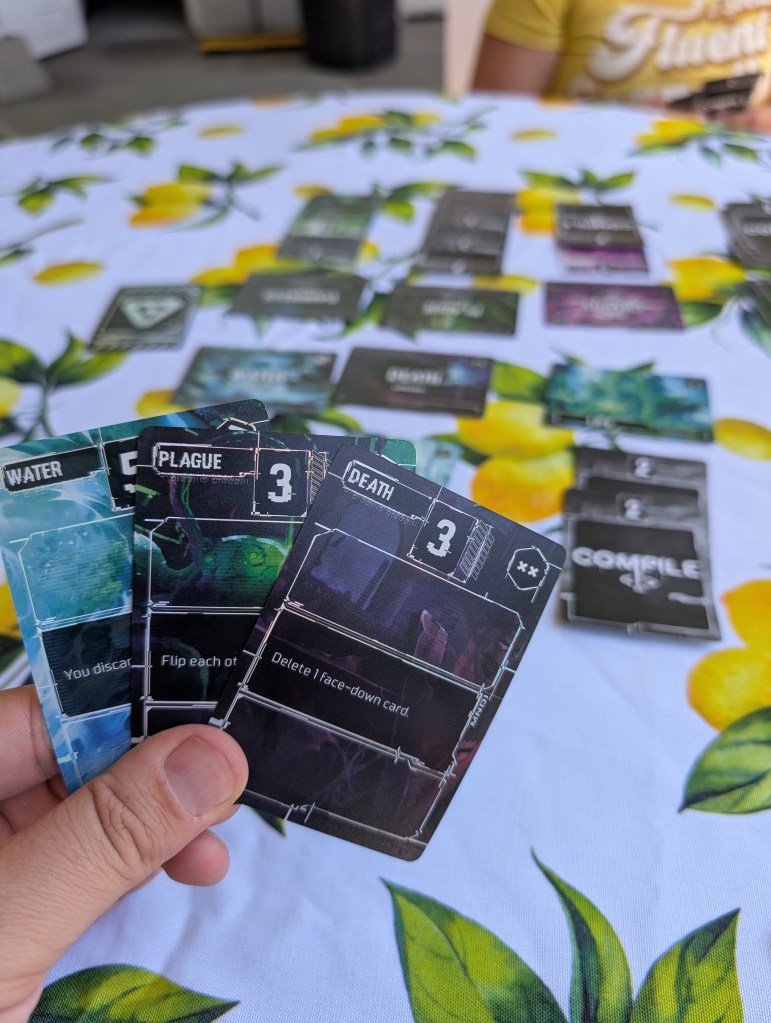
We keep a log of all of our games played here, and try do a yearly challenge to get both breadth and depth from our board game collection. We’ve already hit our requisite number of plays for Compile, but I still want to keep bringing it to the table. It’s a real triumph of design, and comes packed in such a small package, that it’s often the first game to come to mind if we ever want to play a game at a coffee shop. This is absolutely a contender for my favorite card/board game of the year, and I can heartily recommend this to anyone with an interest in clever game play. If you ever run into me, ask to play: There’s a very good chance it’s in my bag.
 Bro Bromero's Broad Blog
Leave a comment