


I swear I have a unique angle to this story: Despite being a white man in his mid thirties, I am actually brand new to this game. I also like to think of myself as a seasoned card and board game player. Still, I somehow got deep into this hobby without ever touching Magic. It’s easy to identify why the game previously never appealed to me: I didn’t want to drop stupid amounts of money on a trading card game. Why would I pay so much for individual cards when I could get entire board games for a comparable price? Is it this cool new Final Fantasy set? That certainly helped push me to buy in, but ultimately, that wasn’t the selling point. I’ve been mulling it over for a few weeks, and I thing it can boil down to one thing.
It gives me access to a third space.
In the United States, the venerated third space is being obliterated. We go to work, we burn out, and go home to recover. Our social fabric is stretched ever thinner as meetups with friends are meticulously planned out on a calendar, months in advance, leaving little room for spontaneity unless you’re lucky enough to keep your friends extremely local. Where does one meetup? There’s an expectation of spending money almost anywhere you go. Precious few places are free of financial pressure, so to keep social outings reasonably priced, I often end up at a friend’s house. I love quiet, intimate friendships in the domestic space, but they also have their limitations. How do you grow a friend circle as an adult? My jobs are working with children, so I don’t have the traditional opportunity to bond with coworkers. I’m still relatively new to my community, so if I want to meet up with old friends, I’m making a 120+ mile round trip to visit them. How do you build local community?
My Magic journey began through an entirely different card game, Netrunner, which I still think is the undisputed king of card games, but that’s a bunch of words for another day. Netrunner (Like Magic, also originally designed by Richard Garfield!) is a run by a nonprofit fan group nowadays, so the community is small. Small enough that when I reached out to play locally in the Inland Empire, I didn’t get a response for a long time. A new player eventually reached out to me, and we were able to fit in some games monthly, but card game communities thrive on larger groups, fertile grounds for player expression and burgeoning metas to flourish. Two people wasn’t going to cut it, and I don’t have the raw charisma to will an entire Netrunner group into existence. Months later, he asked me: Do you play Magic?
Magic began in 1993, three years before Netrunner. These games had drastically different trajectories. Netrunner is a cult classic, but Magic is an institution. I’ve been to board game stores and card game shops for more than a decade, and instinctively knew to avoid them on Fridays, because that’s Friday Night Magic. You can walk into almost card game store in the country on a Friday, and have a solid shot and getting a game of Magic in. It was a community size that I envied when I was a regular Netrunner player. It was time to use that popularity for my own good.
I recognize this is a different sort of post. I haven’t even talked about the mechanics of Magic, and frankly, it feels a bit silly for me to do so: It’s Magic. I had never played it, but I felt it’s impact ripple through the worlds of games, analog and digital, that I enjoyed so much. I fell in love with Netrunner because that game feels like a convergent evolutionary point for card games. There’s a branching time line where Netrunner spawned dozens of card games not focused on dudes beating up other dudes, but that’s not what happened. Instead of bemoaning what the world isn’t, I decided it was worth looking into what the grandfather of collectible card games had to offer in the modern era.
The comprehensive rules of Magic is an almost three hundred page document, but I have found the community to be extremely welcoming. Everyone is always learning the game to some degree, and there are endless facets of it to explore. With a card pool so gargantuan, the sky is the limit on the level of player expression the game offers. The format I play is Commander, which has you running a 99 card deck, with one extra card that’s always available for you to get into play. In many ways, it reminds me of the identity system I fell in love with in Netrunner. I’m still early enough in the game that I need to ask about every card that hits the table, but that just makes it a rush. There is so much information to absorb every game.

I come back from my Magic nights mentally stimulated, but more importantly, socially satisfied. I look forward to future outings, and am relieved that I can guarantee a seat at a table almost anywhere I go. I finally have a third space to both express myself as a big dork, and build local friends.
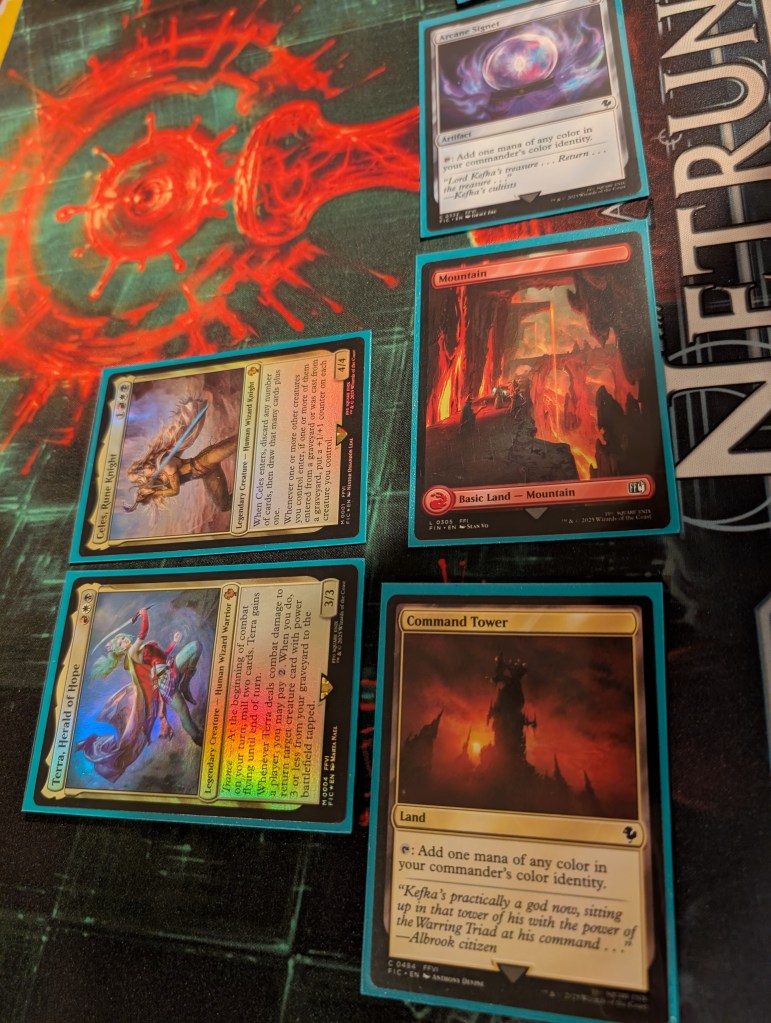
My own commander deck even feels like an encapsulation of my feelings about what the game is doing for me so far. It’s the Final Fantasy VI preconstructed deck. I’m not going to gush at length about that game here, but the deck captures the second half of the game, where you’re assembling a scattered group of friends from a world that has fallen completely into ruin. The familiar world is falling apart, so you have to gather your comrades from disparate places to rebuild community and feel whole again. The world is on fire right now, but at least I can find some local community at long last.
 Bro Bromero's Broad Blog
Leave a comment